

With Justification and Remediation, Irion offers two distinct responses when a check flags an anomaly: accepting and formally justifying the outcome when the anomaly is explainable, or initiating a structured correction to the source system. In either case, every decision remains tracked, documented, and available for audit purposes.
Data Quality as a Governance Discipline
In recent years, data has become a strategic asset in every respect, and with it Data Quality has grown into a discipline of major importance: no longer a purely technical matter for specialists, but a structured set of processes, responsibilities, tools, metrics, and business controls.
In a landscape where data keeps growing in volume and complexity and feeds an ever-greater number of processes and decisions, monitoring its quality and catching anomalies early has become a fundamental requirement for any data-driven organization. Reliable data is the basis for sound decisions, efficient processes, regulatory compliance, and trustworthy analysis. And today the stakes are even higher: an Artificial Intelligence model fed with inconsistent data produces unreliable results at scale. AI amplifies both the value of high-quality data and the impact of unreliable data — which is why data quality is the real prerequisite for any AI initiative.
For exactly this reason, managing Data Quality means far more than running checks: it means governing it. It means defining who is responsible for what, setting reliability standards aligned with business objectives, and measuring the system’s effectiveness over time. These are concrete, operational questions: Who decides whether a piece of data is reliable enough for a regulatory report? What happens when the same check flags the same anomaly in every cycle? How do you prove to an auditor that a known anomaly was assessed, and not simply ignored? And above all: what should happen when a check flags an anomaly?
The Hub & Spoke Model
To make Data Quality a genuinely governed process, Irion EDM® has adopted a hub-and-spoke architecture. At the center sits the hub (Valera & Vellella, 2024), the single point of reference for everything concerning the governance of data quality: it organizes the checks, gathers the outcomes, calculates summary quality indicators, and supports validation processes. Around it operate the so-called spokes — the true controls factories (Valera & Seno, 2023) — since they design, operationalize, and run the checks directly on the various source systems.
The outcomes produced are then sent to the hub, which consolidates them and ensures they are managed consistently and centrally. This way, checks run directly where the data resides, without moving large volumes of information into a single centralized environment: only the check outcomes travel to the hub, where they are consolidated and managed coherently.
Today, the Data Quality Hub module in Irion Premium Data Quality & Governance® already serves as the single point of reference for everything concerning check outcomes. Beyond monitoring their flow — how many outcomes have been received, from which systems, and whether there are anomalies or gaps against expectations — the hub manages the entire lifecycle of the outcomes in a structured way, following a fit-for-purpose logic: it makes it possible to certify data quality according to its specific intended use, giving the business reliable, contextualized information consistent with the requirements of the process that will consume it.
Not All Anomalies Need to Be Corrected at the Source
When a quality check flags an anomaly, there is one instinctive reaction: open a ticket, ask whoever manages the upstream system to correct the data, and have the check re-run. This is the classic flow, and it is exactly what the Data Quality Hub module supports through Remediation: the flagged outcomes are selected, and a ticket is automatically opened in the ticketing system, notifying those responsible for the spoke involved (the External System) so that the data can be corrected and the check re-run.
But when a check flags an anomaly, the outcome is, as a rule, correct: the check has done its job. What changes is not the validity of the alert, but the appropriate response. An upstream correction is not always needed. Anyone who works with data quality day to day knows that an “out-of-threshold” value is often perfectly explainable: a one-off business event, a regulatory change not yet reflected in the data, a known and already-accepted edge case. In these cases, asking the spoke to “redo the work” is pointless and only creates noise: the anomaly simply needs to be justified and documented.
Justifying and Accepting an Anomaly: Justification
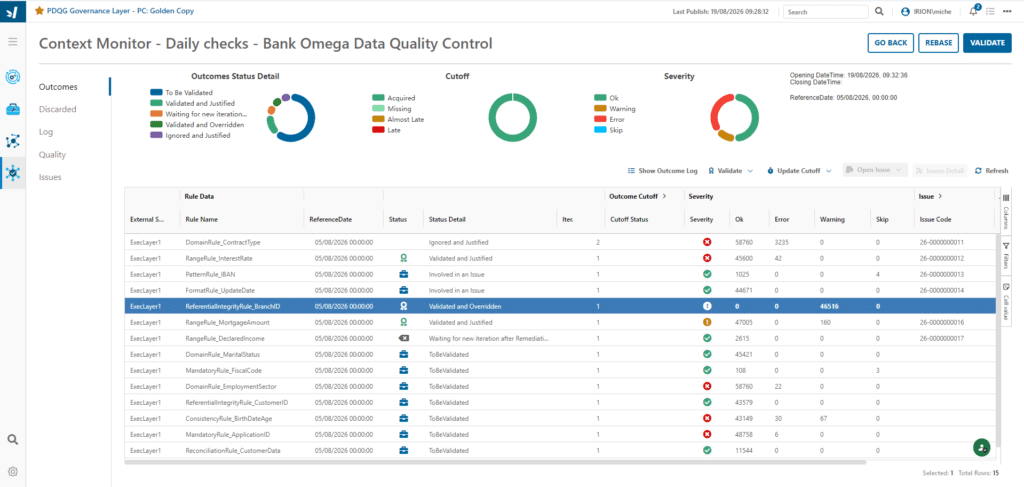
For these cases there is Justification: the way to formally close an outcome flagged as an anomaly without involving the external system.
- Formally justify the anomaly, leaving a note that remains available for audit purposes at all times.
- Apply a severity override: the outcome’s statistics are reclassified — an Error or a Warning can become OK — and the outcome is accepted, with full traceability of the original values and severity levels retained.
A Real-World Example
Typical cases are easy to recognize. The most common is recalibrating a threshold after a migration: a check verifies that a customer’s risk rating in the internal system matches the one calculated by the official rating engine, within a maximum tolerance of 0.5%. In production, the mismatch climbs to 0.8% — but the cause is known: the population includes legacy customers migrated from older systems, whose ratings were never recalculated with the new engine’s logic. The outcomes are correct with respect to the rule: the threshold simply needs to be recalibrated on real production data, and in the meantime the outcomes already recorded should be accepted and kept on record. The flagged outcomes are selected and justified with a note — for example, “threshold to be recalibrated after production migration” — while work on revising the check continues in parallel, with no one left waiting.
The same pattern applies to other recurring situations: categories or classes that fall outside the rule’s initial conditions, one-off business events, regulatory changes not yet reflected in the data. In all these cases, Justification makes it possible to document the decision, retain traceability of the original data, and close the outcome without triggering an upstream correction.
Handling Outcomes: Individually or in Homogeneous Sets
Justification can be applied to a single outcome or, in one operation, to an entire homogeneous set of outcomes. Remediation of multiple outcomes, on the other hand, always goes through opening an Issue: the logical container that gathers the flagged outcomes and enables their structured management when coordination, the involvement of other people, and a lifecycle worth tracking over time are required.
At any moment, the Issue records owner, priority, category, due date, collaborators, attachments, and a complete history of everything that has happened: who did what, when, and with what effect on the outcomes involved.
Within a single Issue, both actions can be used: requesting Remediation for the outcomes that need correcting and applying Justification to the others — for example, when the reprocessing does not arrive in time. Justification and Remediation remain two distinct actions on an outcome; the Issue is what makes it possible to orchestrate them across many outcomes at once.
When an Anomaly Has a Time-Bound Explanation
Some anomalies have a known cause that is limited in time: they hold for a defined window, after which the situation changes. Automation Policies exist for these cases: they let you configure a Justification or Remediation logic once, with a validity date, and apply it automatically to every outcome that meets a user-defined rule for the entire specified period. When the validity period expires, the outcomes are evaluated again.
The principle is the same as with the manual tools: every action is tracked, every decision documented, and the team keeps full visibility into what is happening. Policies remain visible, editable, and can be disabled at any time.
Dashboards for Governing Outcomes
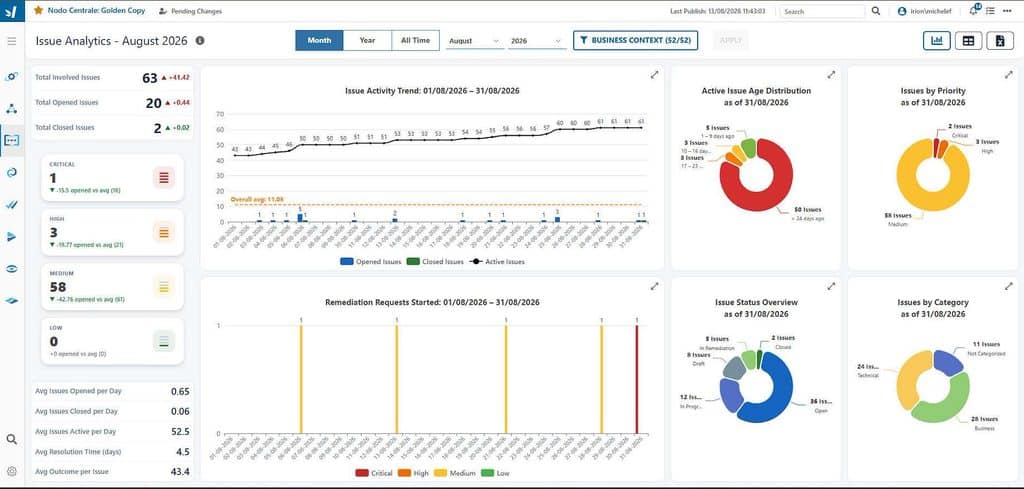
So that everything stays under control, the Data Quality Hub provides two dedicated dashboards: one focused on Issues and one on outcomes, designed to give immediate, multi-level visibility into everything concerning anomaly management and the outcome lifecycle.
These are analytical tools, with interactive charts filterable by period or by priority, built to quickly answer the operational questions that really matter: Are critical Issues rising or falling? How many anomalies have been flagged in the last six months? Which outcomes have led to the most Issues being opened? How many Issues are opened on average each month? These insights make it possible to build a virtuous cycle that steadily improves the reliability of your data.
The Benefits
Justification, Remediation, and Automation Policies are not three separate features: they are three answers to the same question — how to manage and resolve an anomaly so that the decision made today stays understandable, verifiable, and defensible over time.
The first effect is felt in time: you are not left waiting on a reprocessing cycle when the anomaly is already acceptable, and you do not lose the thread when reprocessing is in fact needed. Known, expected anomalies stop demanding attention at every cycle, freeing human judgment for what truly deserves it: new exceptions, ambiguous cases, situations that fall outside the pattern.
There is also a less obvious — and perhaps more important — benefit: the process becomes governed and repeatable. When a justification or a remediation request always follows the same logic — manual or automatic — it no longer depends on the individual or on the workload of the moment. For anyone who has to demonstrate to an audit that the process is governed, every action is tracked and always available when needed.
And there is accountability: it is always clear who decided what and when — not because someone remembers, but because every action on the outcomes is attributed, dated, and set in context within the system.
On top of all this come the KQI metrics: the dashboards dedicated to Issues and outcomes make it possible to read, at any moment, the overall health of the system — how many anomalies are still open, for how long, at what priority, and whether the trend is improving or worsening.
To see it in action, request a demo: we will show how Justification and Remediation in Irion Premium Data Quality & Governance fit into your workflow from day one.
FAQ
Justification is the action of formally accepting an outcome flagged as an anomaly, with a stated reason, without correcting it at the source. It requires an explanatory note that is always available for audit purposes and may include a severity override — statistics classified as Error or Warning can be changed to OK — while retaining traceability of the original values.
Remediation triggers a correction of the data at the source: it opens a ticket to the source system (External System) so the data can be corrected and the check re-run. Justification, instead, accepts and documents an explainable anomaly without involving the external system. These are the two possible responses to the same anomaly, and they are alternatives: for each outcome, you either justify it or start its remediation.
An Issue is the logical container that gathers a set of flagged outcomes to manage them in a structured way. It has its own lifecycle and is characterized by owner, priority, category, due date, collaborators, attachments, and a history that is always available for audit purposes.
Automation Policies automatically apply Justification or Remediation logic to the outcomes that meet a user-defined rule, within a time window with a validity date. Configured once, they remain visible, editable, and can be disabled at any time, with every action tracked and documented.
The Data Quality Hub is the module in Irion Premium Data Quality & Governance that centralizes the management of quality-check outcomes. It monitors their flow, governs their entire lifecycle following a fit-for-purpose approach, and provides the Justification, Remediation, and Automation Policy tools.
References
- Valera, R., & Vellella, M. (2024). Data Quality Hub — Il «cervello» dei controlli sui dati [Data Quality Hub — The “brain” of data controls]. Irion. https://www.irion-edm.com/resources/data-quality-hub/
- Valera, R., & Seno, G. (2023). La fabbrica dei controlli: Dove nasce il valore della Data Quality [The controls factory: Where the value of Data Quality is created]. Irion. https://www.irion-edm.com/resources/the-controls-factory/