

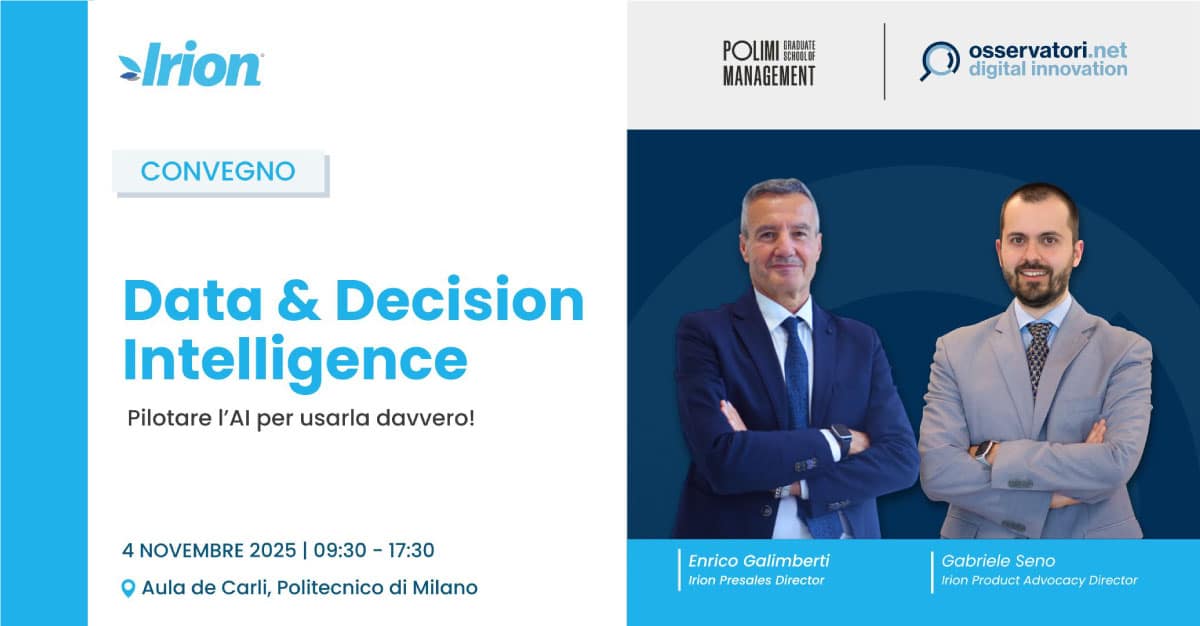
The annual growth of the Italian Data Management & Analytics market is confirmed at +20% (also in 2025), exceeding the threshold of four billion euros, with large companies (250-1000 employees) as the driving segment. This is highlighted by research from the Big Data & Business Analytics Observatory at the Politecnico di Milano, of which Irion is a partner, and which will change its name to “Data & Decision Intelligence” in 2026 to celebrate the fundamental role of data (when it is of high quality) in business decisions.
Data Management & Architecture software recorded a +13% increase: among the most requested solutions in 2025 are Data Catalog & Metadata Management, together with Data Quality & Lineage (40% of the companies surveyed plan to introduce them in the next 12 months). This year’s report involved 112 large companies and 500 SMEs: small and medium-sized enterprises say they are increasingly interested in analytics (89%), but occasional analyses are on the rise, mostly using spreadsheets and without dedicated support.
Governance that (doesn’t) exist: manual activities and untapped AI
The survey highlights a paradox: companies invest, but struggle to transform data into value due to inadequate architectures and poor data and process governance. Only 38% of large organizations have clearly formalized their
And in SMEs, silos remain: “they do not integrate different data sources in any way, or do so exclusively through manual activities,” the research points out. The path to be taken therefore requires “an increasingly marked convergence between Data Governance and AI Governance.” A recurring theme of the conference (among the leading companies: Sky, Costa Cruises, and A2A) was the need to move from a fascination with generative AI to concrete implementation.
Irion talks to LLM: updating data controls with a prompt
A paradigm shift in the approach to Data Governance & Quality: bidirectional integration between Irion EDM and Large Language Models
allows for two complementary modes of interaction. First, the Irion EDM platform exposes data, metadata, and dispositive actions via the standard MCP protocol, allowing LLMs themselves to interact directly and operate, even from a dispositive perspective.
For example, it is possible to modify the threshold of a data quality check with a simple prompt of a few words: during the event at the Politecnico di Milano, Gabriele Seno (Product Advocacy Director at Irion) demonstrated this use case related to Data Quality, but the potential is much broader, for example in the field of data lineage and an entire Data Governance system. LLMs therefore allow you to communicate with Irion EDM using natural language, as we have been accustomed to doing for three years now with ChatGPT, Gemini, Claude, and Perplexity.
How integration works: MCP and API
All this is possible thanks to the Modern Context Protocol, which has now become the market standard with which these tools “speak the same language” as external applications and connect. Essentially, a data environment organized and structured within Irion (“book”) exposes some of the platform’s capabilities through APIs (Application Public Interface).
Seno showed how to query—using simple text prompts in Claude‘s conversational interface—a data model in Irion and ask it to read entities, relationships between data, and links. In this way, any chatbot can fully interact (even in writing, for example by modifying the thresholds of a quality check) with the features made available by the Irion server.
In a typical scenario, a data owner can therefore:
- Request statistics and trends on Key Quality Indicators (KQI)
- Focus on anomalies and violations
- Drill down into the data
- Follow up and, above all, modify the rules themselves
The AI-powered assistant calls up Irion’s APIs and provides a direct link to the modified rule for immediate verification by the (human) specialist. It is therefore not a simple consultation, but a two-way operation.
MCP is also becoming the backbone of the new “agent-based” AI era, centered on digital assistants that are already capable, in many cases, of performing operations with a high degree of autonomy: for example, monitoring a folder and then dynamically activating the right data pipeline (upon arrival of a new file) and producing, as output, an automatic report to be sent via email.
The three key factors of Irion’s advantage
The founding approach of the Irion EDM platform places it at the forefront of integration with these innovative technologies for at least three reasons:
- Intensive use of metadata: LLMs read and navigate the data model with ease
- Standard language: the platform works with SQL, avoiding proprietary syntax (there is no need to train an LLM on specific dialects: complexity is reduced).
- Secure approach: thanks to the advanced change management and rule control features offered by Irion (in particular the Playground), users can experiment, simulate changes, and test the impact of actions activated by LLMs in complete safety, with full control and traceability. This secure environment, rather than a low-tech sandbox, is an accessible user space designed for AI-guided experimentation.