

Data architectures are increasingly distributed and analytical workloads increasingly intensive. For many organisations, the question is no longer just where to store data, but where and how to run compute: and the answer lies in assigning each workload to the most suitable engine, without replacing what already works.
A new architectural question
For a long time, the central question in data architecture was a single one: where to store data. Today, enterprise ecosystems are distributed: relational databases, cloud services, Lakehouses, Cloud Data Warehouses and file systems coexist, each serving different needs. In this landscape, the ability to combine distributed data becomes as important as the ability to store it, and the question shifts: no longer just where data resides, but where and how to run analytical compute efficiently, sustainably and under governance.
This is not an abstract issue. Relational databases remain essential for persistence, consistency and transactional processing. Large-scale aggregations, profiling, simulations, data quality checks and cross-source queries, however, have characteristics of their own: they operate on large volumes of data, often read only a few columns, and require elastic, isolated compute. And as Artificial Intelligence projects accelerate the need for governed data and robust pipelines, the question is no longer whether to modernise the architecture, but how to do so without full replacements or big-bang migrations.
Four signs an architecture is ready to evolve
The need to separate compute from storage rarely arises as a decision made on paper. It emerges from operational signals that many organisations recognise in their day-to-day work. None of them means the current architecture is wrong: they mean the requirements have changed.
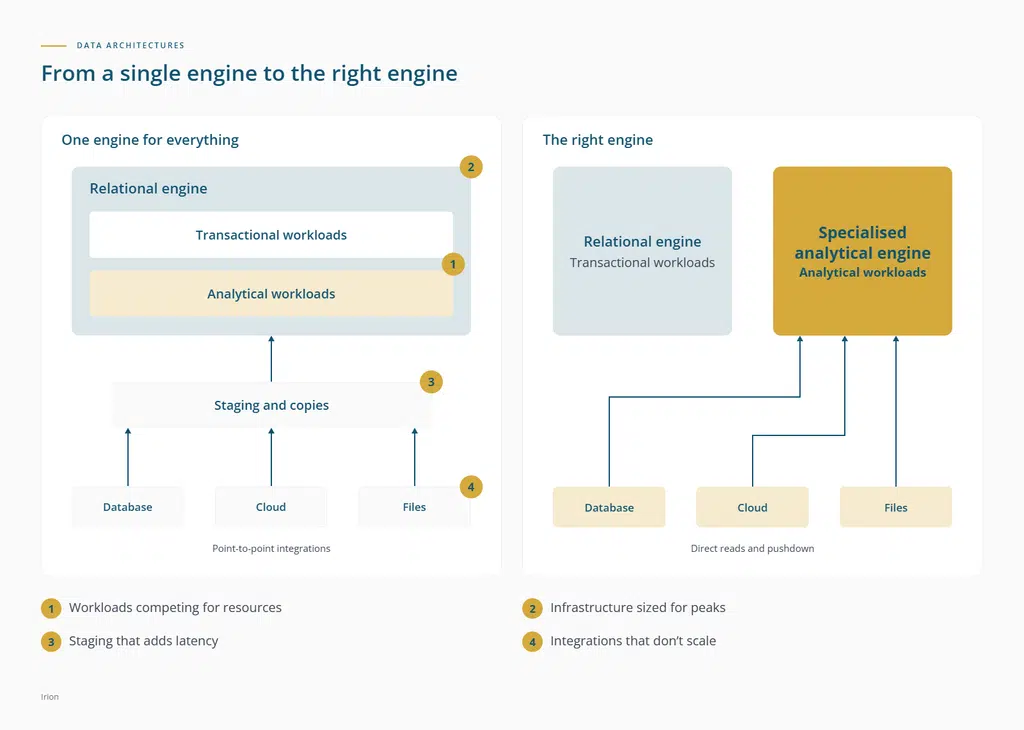
1. Different workloads compete for the same resources.
As analytical processing grows, it ends up sharing resources with transactional processes. A large-volume aggregation can then affect the responsiveness of systems that must guarantee consistency and operational continuity. The problem is neither workload in itself, but running both on the same engine.
2. Relational infrastructure grows to support analytics.
To handle the most intensive processing, organisations tend to add resources to their relational databases. It is an understandable response, but it leads to sizing the infrastructure for analytical peaks, with an impact that also extends to licensing, often tied to the number of cores.
3. Staging and copies add latency without adding value.
Moving data into staging areas or intermediate repositories before it can be analysed lengthens lead times and multiplies the copies to be maintained and governed. Every extra step is a point where data ages, gets duplicated or requires additional checks.
4. Point-to-point integrations don’t scale.
As sources grow, connections built one at a time become hard to maintain. Every new source requires new integration work, and combining data of different kinds becomes a project in its own right.
The diagram compares the two models: a single engine for all workloads, with the four signals just described, and the distribution of processing across specialised engines.
Separating compute from storage
The answer to these signals is not to replace what works, but to make the architecture more modular. The principle is simple to state: data stays in the systems best suited to store and govern it, while each workload is assigned to the engine best suited to run it. Transactional processes keep running on the relational engine; intensive analytical processing is handed to a specialised engine, designed to read large volumes and combine different sources.
Separating does not mean dismantling. The relational database is neither replaced nor stripped of its role: it simply stops carrying loads that are not its own. This is why separation can happen progressively, one workload at a time, protecting the investments already made in technology, processes and skills.
For separation to deliver value without adding complexity, however, a few conditions must be met.
The same tools and the same pipelines. If the analytical engine requires a separate development environment, new languages or separate orchestration, the complexity removed on one side comes back on the other. Separation must happen in how processing is executed, not in how it is designed.
Workload isolation. Intensive processing must run in a dedicated space, so that it does not affect the continuity of other services. It is isolation, more than raw speed, that resolves resource contention.
Independent scaling. Compute must be able to grow on its own terms, without dragging along the sizing of the system that stores the data. This is what makes it possible to stop sizing relational infrastructure for analytical peaks.
Reaching data where it lives. Open formats and the ability to push part of the processing down to the sources, where they allow it, reduce staging and copies. With one caveat: data cannot always stay where it is, and some processing still requires transferring or materialising it. The goal is to move only what is needed.
Governance end to end. Compute and storage can evolve separately only if they remain coordinated within governed pipelines, where every step is traceable and repeatable. Fast but ungoverned analytical capacity moves the problem rather than solving it.
How to decide: questions to ask
There is no universally right moment to separate compute from storage, nor a reference architecture that fits everyone. There are, however, a few questions that help determine whether, where and how to act.
Which workloads weigh most, and where do they run today?
Mapping the most intensive processing (aggregations, simulations, data quality checks on large volumes, cross-source analysis) and the engine it runs on is the first step. Often a handful of workloads generate most of the resource contention.
Where does data reside, and how much does it move before being analysed?
Counting staging steps, intermediate copies and point-to-point integrations gives a concrete measure of what the current architecture costs in latency and maintenance.
What does it cost to grow the current infrastructure?
If growth in analytics translates into new resources for the relational database, it is worth assessing the overall impact, licensing included, and comparing it with the alternative of assigning those workloads to a dedicated engine. The benefit must be verified case by case, depending on the workloads and the context.
Which tools, processes and skills do you want to preserve?
Sustainable modernisation builds on what the team already knows. The more the new capability fits into existing tools, the lower the cost of change.
Does governance follow the processing?
Every new compute capability must stay within the existing perimeter of traceability and control. If it doesn’t, it creates new blind spots exactly where data is transformed.
Irion’s approach
Irion addresses this question with the Analytics Engine, a capability of Irion EDM® Application: a specialised SQL engine for analytical processing on large volumes and heterogeneous sources, which works alongside the relational engine based on SQL Server. Intensive processing runs in a dedicated, isolated compute service whose capacity can scale independently; transactional processes stay on the engine designed for them.
The Analytics Engine is used with the same tools and in the same pipelines already in use in Irion EDM, together with the other processing engines, with no separate environments. It works with open formats, connects to cloud object storage, Cloud Data Warehouses and Lakehouse architectures and, where the source allows it, pushes part of the processing down to the source itself. It is not positioned as an alternative to the data platforms already in place, but as a capability that fits into the existing architecture and returns results to governed pipelines.
In this way, the existing architecture remains the starting point: capacity is added where it is needed, without calling into question the systems, processes and skills already in place.
Further reading
FAQ
It means leaving data in the systems best suited to store and govern it, and assigning each workload to the engine best suited to run it. In practice, transactional processes stay on the relational database, while intensive analytical processing runs on a specialised engine, with compute that scales independently.
No. The relational database remains essential for persistence, consistency and transactional processing. Modernisation can happen progressively, adding a specialised engine for analytical workloads alongside it and moving one workload at a time.
The most common signs are four: analytical and transactional workloads competing for the same resources; relational infrastructure sized for analytical peaks, with an impact on licensing too; staging pipelines and copies that add latency without adding value; point-to-point integrations that don’t scale as sources grow.
Not necessarily. Open formats and the ability to push part of the processing down to the sources make it possible to analyse distributed data while reducing staging and copies. Some processing still requires transferring or materialising data: the goal is to move only what is needed.
The Analytics Engine is a capability of Irion EDM Application: a specialised SQL engine for analytical processing on large volumes and heterogeneous sources. It works alongside the relational engine based on SQL Server and runs intensive workloads in a dedicated, isolated compute service, within the same governed pipelines.
No. The Analytics Engine works alongside SQL Server and lets you assign each workload to the most appropriate engine. In high-transaction, high-concurrency contexts, the relational engine remains the most suitable choice.